


- Director: Ugo Bienvenu
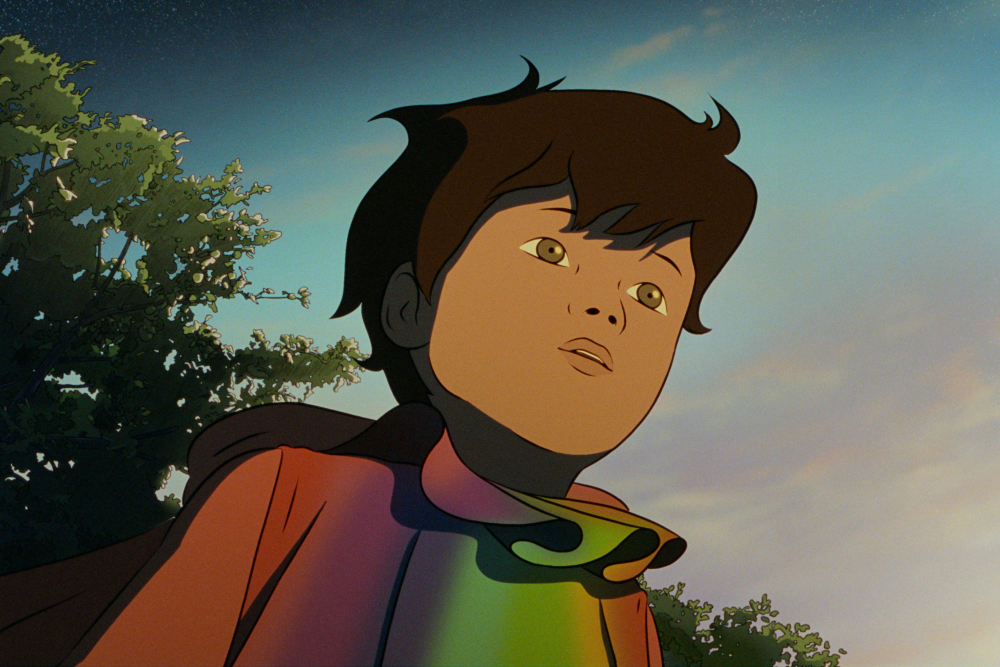
I’ll admit it: I’m tired of the apocalypse. After years of watching animated futures defined by rust, rubble, and ruin, I walked into Ugo Bienvenu’s Arco expecting another lecture on our inevitable doom. Instead, I found myself holding back tears at the sight of a rainbow-clad boy surfing through time. Produced by Natalie Portman and boasting a surprising A-list voice cast, Arco is that rare sci-fi gem that dares to be optimistic—a “solar-punk” fable that prioritizes wonder over cynicism.
A Tale of Two Futures
The film hooks you immediately with its setting. We start in 2932, a distant future where humanity has retreated to the clouds and time travel is a casual family pastime involving rainbow-generating suits. Our hero is Arco, a 10-year-old boy who, desperate to join his parents on their temporal vacations, steals a suit and accidentally crash-lands in the year 2075.
This is where the film’s visual storytelling truly shines. While Arco’s home is a Ghibli-esque utopia of floating gardens, the 2075 he lands in feels uncomfortably close to our own reality. It’s a world of climate anxiety where suburbs are encased in glass domes to protect against storms, and parents dial in via hologram to eat dinner with their kids.
I was particularly taken with Iris, the lonely girl who discovers Arco. Living with her robot nanny Mikki—voiced with surprising warmth by both Natalie Portman and Mark Ruffalo in the English dub—she grounds the film’s high-concept fantasy in genuine emotion. The friendship that blossoms between her and Arco reminded me of E.T. or Ponyo, capturing that specific, fleeting magic of childhood connection where language barriers (or time barriers) simply don’t matter.
The Art of Hope
Visually, Arco is a knockout. Bienvenu, a comic artist by trade, rejects the glossy 3D look of modern blockbusters for a hand-drawn 2D aesthetic that feels like a moving Moebius strip. The animation is fluid and expressive, particularly in the way it renders light and water. When Arco activates his suit, streaking across the sky in ribbons of color, it’s pure cinema magic.


I also appreciated the film’s refusal to be miserable. Yes, the 2075 timeline is fraught with environmental danger, but the film doesn’t wallow in it. Instead, it focuses on resilience. It asks: How do we find joy even when the world is burning? That message felt incredibly necessary to me.
Where It Stumbles
However, I can’t ignore the film’s clumsy attempt at comic relief. For reasons I still can’t quite grasp, the antagonists are a trio of bumbling conspiracy theorists voiced by Will Ferrell, Andy Samberg, and Flea. While I usually enjoy these actors, their slapstick antics felt jarringly out of place against the film’s otherwise gentle, melancholy tone. Every time they appeared on screen, I found myself checking my watch, waiting to get back to the emotional core of Arco and Iris.
The pacing also suffers in the third act. The film moves at a breakneck speed, rushing through its climax so quickly that the emotional payoff, while sweet, didn’t land as hard as it could have if we’d had just ten more minutes to breathe.
Conclusion
Despite these narrative hiccups, Arco won me over completely. It is a sincere, visually dazzling love letter to the future that respects its audience enough to be hopeful. If you, like me, are looking for an escape that doesn’t just distract you but actually lifts your spirits, this is the film to see.
My Rating: ★★★★☆ (4/5)
Leave a Reply Cancel reply