
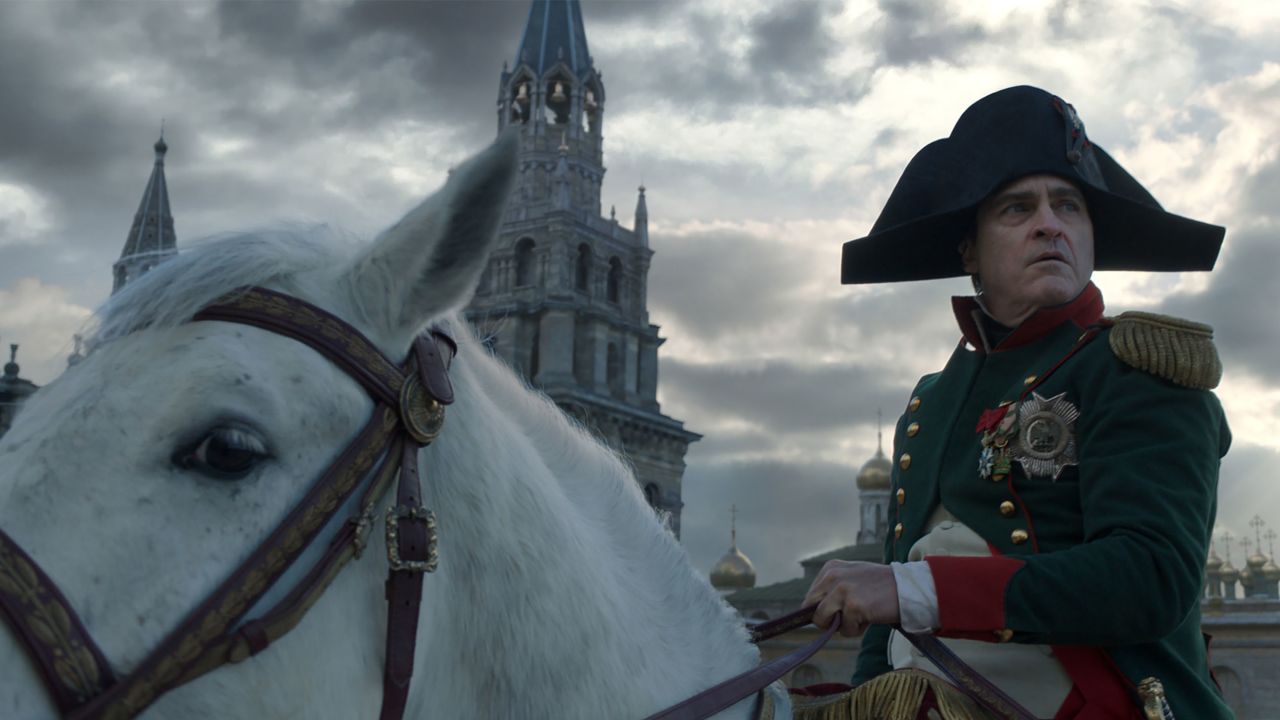
Ridley Scott stormed back to the screen with the promises of glory, drama, and spectacle in the wake of Gladiator, but in the end with Napoleon was only able to deliver the spectacle part. Great grand spectacular action set pieces, where you don’t end up feeling the stakes or drama because of how flat and messy the rest of the film is. With near zero attention put into historical accuracy and writing, the film doesn’t deliver on much more than just the spectacle, and set pieces. Both Joaquin Phoenix and Vanessa Kirby give some of the weirdest performances of their careers, credit due to the odd script they were dealt.
The narrative unfolds with a focus on Napoleon’s peculiarities, showcasing Phoenix’s portrayal of a character with moments of sheer absurdity. From dozing off with open eyes during crucial political discussions to engaging in a bizarre conversation with a British ambassador about boats, the film underscores Napoleon’s unconventional nature. One particularly peculiar scene involves Napoleon inspecting a mummy in Egypt, climbing onto a crate as though expecting guidance. Even during a heated argument with his wife Joséphine, played with bemusement by Vanessa Kirby, Phoenix’s Napoleon delivers lines like, “Destiny has brought me this lamb chop!” with a disorienting blend of maturity and oddness.

While Phoenix’s portrayal may deviate from historical accuracy in terms of height and age, the actor’s commitment to the character’s eccentricities remains commendable. The film cleverly contrasts Napoleon’s battlefield prowess with his clownish behavior, creating a unique cinematic experience. Despite the film’s overall limitations, Phoenix’s performance emerges as a strange yet rewarding spectacle.
Ridley Scott, known for his mastery of historical epics, struggles to recapture the success of films like “Gladiator.” “Napoleon” alternates between epic battles and peculiar moments from the protagonist’s marriage, attempting to weave a cohesive narrative. Unfortunately, the film falters, lacking the engaging storytelling seen in Scott’s previous works. The emphasis on juxtaposing clownishness with battlefield prowess becomes the film’s primary focus, overshadowing any deeper exploration of Napoleon’s character.
The film’s opening scenes, featuring a frizzle-haired Marie-Antoinette meeting a grim fate, set a peculiar tone. Attempting to decipher the film’s politics proves futile, as street-level perspectives depict a bloodthirsty mob without providing a broader context. The film presents Napoleon’s rise to power without delving into the intricacies of his rule. This lack of perspective leaves the audience with a portrayal of Napoleon as a perpetual warrior, constantly engaging in battles with sporadic encounters at home.

While the battle sequences are visually impressive, they lose their impact as the film progresses. The Battle of Austerlitz stands out as the most thrilling, capturing Napoleon’s strategic brilliance. However, the repetitive nature of subsequent battles diminishes their significance, resulting in viewer fatigue. The film’s choice to seal off any wider perspective on the country further undermines attempts to characterize Napoleon as a populist strong man.
Despite the film’s flaws, the battle sequences maintain a level of excitement, with the Battle of Austerlitz showcasing a brutal beauty. The film’s deviation from historical accuracy, criticized by some, becomes secondary to its lack of a compelling narrative. “Napoleon” becomes a peculiar journey through history, emphasizing the protagonist’s prowess on the battlefield while sidelining the nuances of his rule.
Final Thoughts:
In conclusion, “Napoleon” is an unhistorical strange tale that leans heavily on Joaquin Phoenix’s weird performance. Ridley Scott’s attempt to capture the essence of Napoleon’s life falls short, with a disjointed narrative that oscillates between epic battles and peculiar personal moments. While the film’s battles are visually striking, they struggle to compensate for the lack of a cohesive and engaging storyline. “Napoleon” may not join the ranks of Scott’s historical masterpieces, but it leaves an indelible mark with its memorable portrayal of a strangely captivating Napoleon Bonaparte.
Watch Napoleon in theaters now!
Leave a Reply